Tuesday, October 6, 2015

Practical Matters: Overload and The Word

by Sarah Kain Gutowski, Chair, New Member Program

You may have noticed a few of the emails coming from Dean Gherardi's office over the past couple of weeks concerning the NORA form -- and you may have wondered, what the heck is a NORA form?

October rose (w/ site of new Eastern Health and Wellness Center)
Good question! And an important one. The NORA is a Notice of Reasonable Assurance. This form is most important for our contingent faculty, who need to let the college know if and when they'll be available to teach classes in the upcoming term. All full-time faculty need to fill out this form too, however, if we'd like to request an overload assignment in the upcoming semesters, including Wintersession (classes held in January), Spring, and Summer I (the first five weeks of classes following the spring semester for traditional, face-to-face classes, and the first eight weeks for fully online classes), Summer II (the second five weeks), and Summer III (you get the picture).

Now that you know what the form is, you may need a reminder about deadlines -- because deadlines are very important. If you want to request a class for Wintersession 2016, you need to submit your NORA form by tomorrow, October 7. As Dean Gherardi pointed out in his emails, assignments will be made by October 15, and you will have until November 6 to accept or decline your assignments.

The deadline to submit an overload request for the spring semester is ALSO October 7.  Assignments for the spring, however, will be made by October 22, and you will have until November 9 to accept or decline your assignments through Banner.
It's important that full-time faculty make their decisions about spring overload as soon as possible because it helps our academic chairs find adjunct faculty who can teach the remaining classes in the spring schedule.
But let's say you're already teaching an overload class this semester. You may be wondering, when am I going to get paid for all of this prep and teaching? Well, if you haven't been accessing your online pay stubs (available through MYSCCC, under the Employees tab), and if you haven't been keeping track of your automatic deposits to your bank account, you may not have noticed that we were just paid for overload courses last week, on October 1. The schedule for the rest of the adjunct/overload payments is as follows:
  • October 15
  • October 29
  • November 12
  • November 25
  • December 10
  • December 23
Additionally, this is what you'll be paid per credit this year for any overload assignments you take on:
  • $1,178 - instructor
  • $1,277 - assistant professor
  • $1,370 - associate professor
  • $1,501 - professor 
You can see more about negotiated overload/adjunct pay for the next few years in our Memorandum of Agreement for 2015-2019, available on the FA web site under Documents >> Contracts.
 
ADDITIONALLY, do you know where else you can find this information? And in particular, the information about overload pay dates? In The Word, the FA's official newsletter. If you're new to the college and/or working in a union shop, one of the best ways to familiarize yourself with the college, its history, and its long, sustainable, beneficial, and most importantly -- positive -- relationship with the union is to read through back issues of The Word (archived on the FA web site) and all of the subsequent MOAs following the 2001 contract (also archived on the web site next to the one I cited above). Both provide a broad perspective, and evidence, of how the union, college, and county work together to provide excellent working conditions and benefits for its classroom and non-classroom faculty, specialists, counselors, librarians, and professional assistants. 

Thursday, October 1, 2015

On Being Ready, Willing, and Able

by Sarah Kain Gutowski, Chair, New Member Mentoring Program

Congratulations! You've worked here for a full month!


It was fantastic seeing so many of you at the first event of the New Member Discussion Series. I hope that those of you who attended learned much from our lovely three panelists, Jared Dowd, Dawn Wing, and Jill Malik. All three gave us a lot of insight into creating balance and establishing positive, working relationships in the first year.

In the next few weeks I'll be posting the notes and talking points from Jared, Dawn, and Jill's presentations, archiving them here on the blog so that those of you who could not attend will still be able to benefit from their individual perspectives and advice. Of course, the only way to benefit from someone else's story is to be willing, first and foremost, to truly hear what he or she is saying. And this leads me to the topic of today's post.

Friday's NMDS: See? We had fun!
Mentoring is not something that happens to another person, an act we bestow or inflict on another living being. Mentoring is a relationship, which means it's symbiotic, and mentors benefit from interactions with mentees as much as the new faculty member gains insight from the veteran member. And for both parties to gain, and feel the benefits of the mentoring relationship, an extremely important element needs to be present: openness.

Such openness to mentoring may seem easy and like a no-brainer to some of you, but for others, particularly if you've been kind of wary of this New Member Program thing, the following excerpt from Hal Portner's "Being Mentored: A Guide for Protégés” (published by Corwin Press, and adapted by NYSUT’s Education & Learning Trust for a seminar they hold regularly on mentoring) might help you get the most out of this next year:

Be ready – “Wholeheartedly accept the opportunity to be mentored”

Be willing – You need to “believe that you have an ongoing need to learn . . . When you are doing something you believe in – when what you are doing sits well with your set of values and is relevant to your life – you will do it better; you will do it with passion.” Additionally, you need to “have confidence that being mentored . . . can make a difference between success and failure.” And lastly, you must  believe that “being mentored can help you remain in the profession and have a satisfying and gratifying career.”

Be able – “Whether you have a mentor who offers little help or support, or a mentor who throws so much information and help your way that you are constantly overwhelmed, or a mentor who is . . . experienced [and] who understands how to work effectively with a protégé, you will still get more out of being mentored if you are ‘able’. Being able means having the knowledge, skills and understanding necessary to be proactive in the mentoring process. Being proactive means not only being ready and willing to access the resources available to you, but also being empowered to do so.”

Finally, NYSUT’s Education & Learning Trust offers new faculty members these “Principles for Success”:
  • Take the initiative when it comes to having your needs met as a protégé.
  • Avoid making assumptions about your mentor’s plans and expectations.
  • Solicit feedback from your mentor as a way to improve.
  • Receive feedback objectively.
  • Attempt to construct ways to learn from seemingly untenable situations.
  • Take responsibility for your personal well-being.
  • Contribute to the learning of other educators. 
So, to these ends, I would take the next step and mark on your calendars the date of the New Member Bagel Brunch that will be occurring on your campus this month. The dates, times, and places are as follows:

October 14 -- Grant New Member Bagel Brunch (Captree 113, 11:00 a.m. - 12:20 p.m.)
 

October 21 -- Eastern Bagel Brunch  (Corchaug 18, 11:00 a.m. - 12:20 p.m.)
 
October 28 -- Ammerman Bagel Brunch  (Alumni Room, Brookhaven Gym, 11:00 a.m. - 12:20 p.m.)

At each brunch, FA officers and New Member Program campus coordinators will be present to answer any questions you may have, tell you a little more about the college, and give you your very own shiny white NYSUT "promotion folder" -- the savvy faculty member's secret weapon when it comes to building (and keeping track of) a successful career.

So: Mark the date of your campus bagel brunch, continue to open my emails and read these blog posts (!), and extend a hand and an open ear when your mentor comes to say hi or checks in via email. We are, after all, ready, willing, and able, too!


Tuesday, September 22, 2015

Practical Matters: Intercampus Travel Reimbursement

by Sarah Kain Gutowski, Chair, New Member Mentoring Program

By next week you'll have completed your first thirty days as full time faculty at SCCC. Congratulations! I hope the transition has been a smooth one. Most of you have been focused on the tasks and duties associated with your particular job title, and many of you have been teaching, but few of you have begun to travel between campuses for committee work.

My afternoon commute. Pretty, huh?
But soon, as the semester picks up, you may have to do just that.

For instance, this Thursday (which is a Wednesday, according to the academic calendar), I will hold office hours and go to an on-campus meeting in the morning, teach a class at 12:30 p.m., and then travel to the Ammerman campus to a meeting of the college-wide distance education committee.

Because my job duties that day begin with work at the Eastern campus, but then also require me to attend a meeting from 3-5 p.m. on the Ammerman campus, as per our contract I can be reimbursed for the mileage between the two campuses. Our contract states: "If a faculty member's full-time duties require travel assignments at more than one (1) campus (i.e., location) per day, the faculty member shall be reimbursed for the mileage between assigned locations."

Cool, right? 

There are a couple of ways to begin this process. One is to visit the SCCC Governance page (I know -- were you even aware that we had a governance page? Did I just blow your mind or what?  . . . Or are you asking yourself, "Governance? What's Governance?" Oh, my friend... This is a story for a whole other post...) and download the PDF titled " Instructions for Intercampus Mileage Reimbursement." This gives you instructions for logging on to your MYSCCC account and downloading the appropriate forms, as well as a run-down of the process for submitting those forms. The caveat here is that the PDF is a little outdated. Banner tabs have changed since this document was created, and so instead of going to the "Finance" tab, you have to go to the "Employee" tab, and then click "Reimbursement Forms" under "Employee Forms and Procedures." So some of the navigation information needs updating, but for the most part it's pretty straightforward.

You may also visit the college's web page about mileage reimbursement, which is thorough and helpful but doesn't include links to the actual forms (again, you have to log on to MYSCCC for these).

All of the information you'll find in these places is important, but here's what I think you should be particularly mindful of:

  1. Our contract covers required travel between 2 or more sites (campuses) in a single day. If  you travel voluntarily to a campus other than your home campus (say, for a professional development workshop!) you still aren't eligible for mileage reimbursement. And even if you're traveling to another campus for a required event (like Commencement in the Spring), you can't be reimbursed for mileage if you're going to be at only one campus that day. Basically, you're reimbursed only when it's absolutely necessary, which makes sense, right?
  2. You should attempt to submit mileage reimbursement vouchers monthly. And the Business Office will accept nothing over three months (90 days) old. So if you're interested in reimbursement, you should perhaps make it a habit -- set aside time at the end of the month -- to go over your calendar and note all of the times you traveled to another campus from your "home" campus (where your everyday duties take place).
  3. There are standard mileage amounts between campuses: Selden to Brentwood is 15 miles; Riverhead to Selden is 23 miles; Riverhead to Brentwood is 34 miles. If you were to travel to a different campus directly from your personal residence (I'm avoiding the use of "home" again because, you know, CLARITY), you have to subtract the mileage you normally travel to get to the office everyday from the standard mileage amounts above.
    1. For example: I live 9.75 miles from the Riverhead campus, where I teach. When I travel to the Ammerman campus on Friday for the New Member Discussion Series event, I'll leave from my house, not from the Riverhead campus. So I should subtract 9.75 from 23 and claim 13.75 miles for that morning trip. Of course, I would only claim this amount if I ALSO had a meeting scheduled at Eastern or at Grant that day, since Friday is usually my non-duty day (I don't teach classes or hold office hours on Friday).
  4. We aren't reimbursed the entire amount, but it's still a pretty nice feature of our contract that we get back 57.5¢ for every mile we travel between a campuses. It's especially nice if you end up on a committee that, for whatever reason, requires you to travel between campuses more than once a month. Those trips can add up!
Mileage reimbursement is just one good example of how the Faculty Association contract ensures that while we're asked to do many different kinds of service and various tasks in the course of performing our jobs, we're compensated and reimbursed accordingly for our trouble and/or efforts. I think we should appreciate that fact, and also take advantage of it! Paperwork is a pain in the arse, sure, nothing's going to change that fact, but it's necessary and perhaps a small price to pay for the benefit it brings.  

Put more bank in your bank, people! Submit those reimbursement vouchers!


Wednesday, September 16, 2015

Practical Matters: Student Activities and Clubs

by Sarah Kain Gutowski, Chair, New Member Mentoring Program
 
On Wednesday of last week, faculty and students here at the Eastern campus gathered on the patio outside the Peconic building for Student Activities Day, a kind of open house for student clubs and organizations. Club officers and advisors were generally on hand to answer questions from students seeking to participate in extracurricular campus activities, and to gain new members in the process. You may have seen something similar occurring on your own campus.

For years now, I've been a faculty advisor to a student organization. For several years while I worked on the Ammerman Campus, I co-advised a student writing group that met to workshop their poetry, short stories, and plays outside of a classroom setting. Then, when I transferred to the Eastern Campus, I began advising the campus literary magazine. From my time as an adjunct to the present, I've always been involved with student activities, and this involvement has kept me engaged and invested in a way that's much different from my experience in the classroom. In fact, I'd say that if anything, it's enhanced my ability to connect with students in a meaningful and productive manner.

I encourage all of you to consider being a student activities advisor as well, and if you’re presented with the opportunity to do so – well, jump at it. All three of our campuses offer our student body a richer, more diverse college experience by providing numerous activities throughout the semester – and by facilitating and supporting a number of different student clubs and organizations. Being an advisor can help you learn so much more about our students than time in the classroom
The super-sophisticated display for the club I advise.
can – and I say this after receiving lots of really personal personal essays in Freshman Comp.

PAs, Specialists, Counselors, Librarians and faculty can become more involved with student life by being an advisor to a student club or organization. Not only is this a wonderful way to mentor students, it’s also a good way to garner some campus-wide service you can cite on your application for promotion.

As an advisor, you’ll need to assist the club officers when necessary (you aren’t required to attend all the meetings, although the presence of an advisor is necessary for any off-campus excursions the club may make). Depending on the campus, you might attend an Officer and Advisor meeting during Common Hour once a month or once a semester. You’ll sign some forms. You’ll be invited to a lovely, catered Student Awards Ceremony at the end of the year. And that’s about all the heavy-lifting that’s involved, unless you’d like to be more active. 
 
The Ammerman Campus in particular needs faculty and staff advisors for student clubs, so if you’re located on the Ammerman campus and you’re interested in becoming involved, contact Frank Vino at x4814. If you are located on the Eastern campus and would like to become involved, call x2531 and let Denny Teason know you’re available to advise; likewise, if you’re on Grant, call Lisa Hamilton at x6260.
 
Lastly, I’ll say this: Because the college is changing constantly to accommodate the needs of our students and community, our roles and requirements as faculty and staff are changing constantly, too. You may find that you’ll join some committees your first year or second year and that by your seventh year, you’ll either be chairing those committees or you’ll find yourself on entirely different committees.
 
Well, I began co-advising The Society of Writers back when I was an adjunct faculty member. Over the years – after being hired as full time faculty and going through the process of two promotion cycles – the one item that’s never changed on my promotion applications is my role as an advisor. I love mentoring students, and I’ve found the experience extremely rewarding, particularly with clubs that are educational in focus, like the honors societies or STEM clubs. It’s a fantastic way for us -- new and “senior” members alike – to connect with our students, and remind ourselves that while academics are (and should be) the primary focus of our energies, student activities further solidify a feeling of solidarity between faculty and students at our school.

Monday, September 7, 2015

Practical Matters: How to Access Your Office Computer Files Remotely

by Sarah Kain Gutowski, Chair, New Member Mentoring Program 

A Rose of Sharon bloom that appeared on Labor Day.
Happy Labor Day, fellow unionists! I hope you spent your Labor Day relaxing and enjoying the beautiful weather. I labored a little, despite the holiday -- there was a house to clean after weekend guests, and some prep to do before classes Tuesday. And in order to do that prep, I had to access computer files that I created back in my office last week -- but I didn't have to use a flash or portable hard drive to do it.

How did you do that? you might ask. Well, I'll tell you (as if you haven't figured that out yet from the title of this post). Far be it from me to encourage laboring over a weekend (and especially a holiday weekend at that), but you should know that if you ever forget to email yourself a document or save it to a flash drive, there's still another way to access your files without driving several (or several + several more) miles back to your home campus.

First, type https://roam.sunysuffolk.edu/ into your web browser (or, you know, click the link and then bookmark it). You'll arrive at this:


Then, enter your MYSCCC login information. You'll be taken to this screen:


At this point you're asked to select the link to your home campus. It's important to note that if you were formerly an adjunct who began teaching on another campus, or even a full-time member transferring from another campus, your files are probably located under your original campus. (ex. I transferred to Eastern from the Ammerman campus last year, and my files are still located under the Ammerman link.)

Click the link and be patient: you'll find a redundant screen that asks yet again for your MYSCCC login, and then you may have to wait while a red "LOADING" sign appears in the top right hand corner of the screen.:


I find that depending on the amount of traffic on the college server or the strength of the wifi signal at my own home, it can take a minute or two for something like this to appear: 


Use the arrows on the top right of the screen to scroll through the list until you find your MYSCCC Login. When you do, click the link, and you'll be directed to another link for your files ("My Documents").

Once you're in there, you can access anything that you created on your office computer and saved to your documents folder. (A word of warning: if you were working on a document and didn't save it, you'll be unable to open it up remotely.) You can even upload documents that you create at home to the school's server, and they'll be ready for you to access once you return to the office. All in all, this little tool is a pretty useful one to remember. Remote access to my office files has saved me time and stress on more than one occasion. May it do the same for you!

Tuesday, September 1, 2015

The Necessity (and Benefits) of Ceremony

by Sarah Kain Gutowski, Chair, New Member Mentoring Program 

By now you've had a whopping two-three days to acclimate to SCCC while classes are in session -- but this will be your first full week at the institution (at least as a full time faculty member). You're bound to have some questions. When you have them, I'd advise you to write them down and save them for your mentor; on Friday, the campus NMP coordinators and I met to brainstorm mentor/mentee pairings -- and so you should be receiving word soon(ish) about who your mentor is, and they'll contact you shortly after that.

Also, you've had the opportunity to attend our annual Convocation -- and that event may have created questions, too, such as: why a convocation? Is this really necessary? 

The answer is that no, convocations generally aren't necessary. In fact, they're a fairly recent part of Suffolk tradition. And sure, it can be a drag to stay on campus longer -- or travel 30-40 minutes to Ammerman from your home campus -- but instead of grumbling or groaning (or maybe after grumbling and groaning, because I was certainly guilty of both), perhaps we should consider why such ceremonies and traditions (whether new or as old as the institution itself) are beneficial. More specifically, we should see what moments of the convocation we can find useful to our daily professional lives as we move forward with the academic year and our careers here at SCCC.

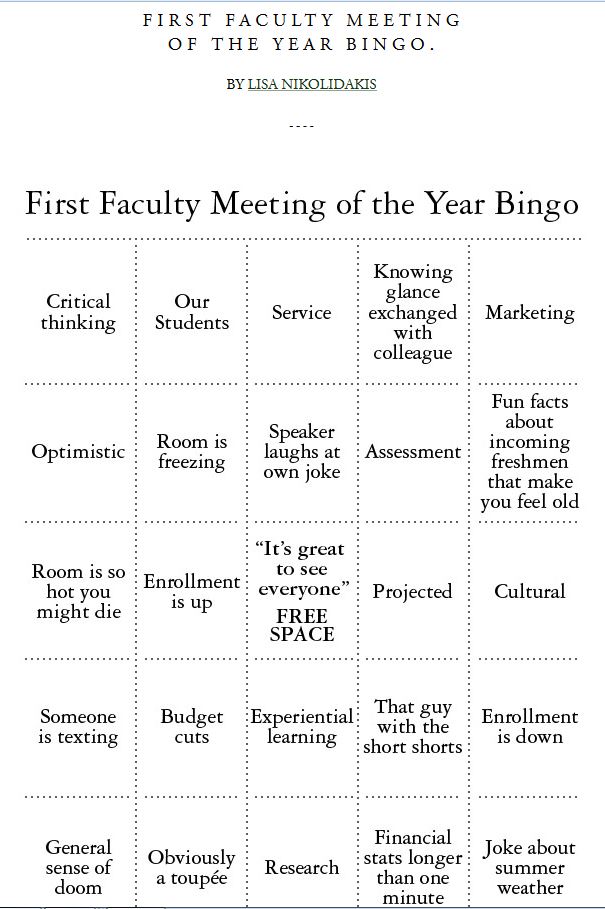
Best. Bingo. Card. Ever.
I can imagine it's disorienting to go to Convocation on your first day at work. You file in to the gymnasium behind fellow faculty you don't really know yet, not knowing what to expect. People are taking photos. For some reason that's not entirely clear to you, there are cheerleaders and a dance team. (Are they usually present at Convocations? you might ask your more experienced neighbor. No, they answer, they usually aren't.)  It's really, really cold. You wish you had a snack. You wish you had your academic robes (or, you feel kind of foolish wearing yours next to faculty who are not . . . but then, the extra fabric sure helps against the cold!). You wish, at the very least, you'd printed out that Bingo card from McSweeney's that's making the rounds of Facebook and Twitter and even, good lord, The Chronicle of Higher Education.

Then things get going. There are some opening remarks, soft joking, a general atmosphere of optimism and celebration that the more cynical of us (author raises hand here) regard with a healthy bit of side-eye. There are a few trending buzzwords from higher ed initiatives thrown around (Hey! "Initiative" -- there's one!). Still, it's interesting to observe how these things work -- these ceremonies, that is -- and what is considered worth celebrating.

Being a wise, wait, wizened, nope, seasoned (yes!) faculty member, here's what I would say is worth remembering: 
  1. The Chancellor's Excellence Awards ceremony. If you are teaching faculty, Thursday's ceremony should, at the very least, make you aware of the awards, and, at the most, help you shape the rest of your career here. These awards are prestigious and competitive, and nominations come from the college community. The nomination and selection process is rigorous at the local level and the SUNY level, and so we should look to these winners not with envy or de-facto admiration, but with a careful and appraising eye. That's not to say that award winners aren't worth our cheers and celebration -- but I'm talking about using the fact of the awards, and their distribution, not as a kind of yard stick (not something you measure your own accomplishments against), but as a source of professional-development information. Specifically: look at the bios of the awardees. Look at their accomplishments, plus the types of service they've completed and the associations they've joined. These are possibilities for your career, too -- particularly as you just begin your tenure here. What looks interesting? What looks challenging? This exercise can be useful when determining what not to do with your career, too. Not everyone gets to be (obviously) a Chancellor's Award winner -- but not everyone wants to be a Chancellor's Award winner. (Although we can all agree we'd like some cool-looking medal-bling for future ceremonies, ammaright?) If you don't want your career to include the kind of activities or markers that the award winners have, what do you want it to include? Anyway, moments like these can help you think about, early on, the kind of career you'd like to have at SCCC.
  2. The Professor Emeritus Awards: Similarly, if you listened to the biographies of the Professors Emeriti (including that of the fabulous Ellen Schuler Mauk, former president of the Faculty Association), you would have heard a long list of varied accomplishments. Here, I would point out that these former faculty members were being honored because they never stopped being active and engaged faculty after their final promotions; none of them sank into an abyss of reclusiveness and anonymity after retirement, but rather remained vigorous participants in (and advocates of) higher education. This is something to observe, and something to marvel at: how they didn't burn out. How they remained invested. It may seem difficult to imagine career burn out at this point, but in about seven years, you may find yourself a little, well, spent. Tired. And if that happens, it might help to remember and consider professors such as these. If you see any of them around campus, ask them to divulge their secrets.
  3. Dr. Suzanne Johnson's speech: As new members, you probably felt that you were getting your first good look at our administration -- President Shaun McKay, Vice President for Student Affairs Chris Adams, and of course, Vice President of Academic Affairs Suzanne Johnson. But what you may not have known is that most of the college community was having their first real introduction to Dr. Johnson, because she just began her tenure as VP this summer. Her keynote speech was optimistic, geared appropriately toward our student audience (the most substantial reason to hold a convocation in the first place), and peppered with some personal information that let us know a little more about who she is and what she values. The most refreshing revelation from this speech (and the most important) was that she, a key member of our administration, sees the community college degree not as a certificate that proves job-worthiness or -readiness, but as process, steps taken to make one a more learned citizen capable of substantial, reasoned and valuable contributions to society. This is a message I attempt to ingrain in my students every semester, as I suspect many of you do as well, but it was particularly heartening at the beginning of the academic year to hear such a sentiment from the mouth of one of our administrators.
  4. The Shark: As yes, the shark. The foam fins! The fanfare! The instrumental Metallica! (C'mon, you know you weren't missing Hetfield's hyperbolic growl.) Some of you may have been thinking, really? A mascot? Is this important and relevant, academically? The answer is, of course, no AND yes. Sure, we could survive as a commuter school without a mascot. And yes, there's often a little too much emphasis placed on sports in higher ed. But it's worth remembering your own undergrad experience, and any sporting events that you attended while there: school mascots provide students with a sense of unity and camaraderie, while the traditional humorous antics provide a kind of cathartic release from the tension that can build from too many hours of studying in isolation. Having a school mascot gives our students one more reason to feel like they belong to a college with a cogent identity, even if they commute daily to that school instead of dorming, and even if that school is divided between three campuses instead of contained in one sprawling mini-city. 
Hopefully, if anything, the Convocation gave you a better sense of the identity of SCCC, for better or for worse. Pomp and circumstance can be a little wearing, I know, and particularly after the stress of a full day of classes -- but it has its purpose, and very real ramifications, and it's important to reflect on those effects, if even for a brief while. Because faculty who are more informed and educated about the institution to which they belong, and faculty who think honestly and critically about the programs and celebrations and values of the institution, are faculty better poised to teach, and serve, and shape the future of that institution.

That's right! You're responsible for shaping the future of SCCC ... No big deal, right?

( Happy first week back!)

Tuesday, August 25, 2015

Welcome to SCCC, the FA, and the New Member Program

Sky at Cupsogue, Westhampton Beach
by Sarah Kain Gutowski, Chair, New Member Mentoring Program

Some of you may be very familiar with Suffolk County Community College already, having been an adjunct here in previous years, and some of you may be brand new to SCCC, as well as to Long Island and New York State. No matter where you've been before this moment, the FA would like to welcome you at the beginning of what may (will probably) be a long and dynamic career at our institution, and help make this transition to being a full-time member of our faculty as seamless and rewarding as possible.

Ten years ago I began my own career here, and the New Member Program, while in its infancy, provided a fantastic orientation to both the school and the way a union works -- for coming from the south where unions were not (still are not) as prevalent as in the north, I was largely unschooled as to how a union works (and works hard) for its members.

But this blog post isn't about how a union works, necessarily -- it's about how you're going to work, in particular, at the beginning of this academic year, supported by fellow faculty who remember what it was like to begin teaching and non-teaching duties at a new institution, and to attempt to build lasting professional relationships with new colleagues.

The first of these professional relationships will most likely be with your office mate, or with a small handful of people in your department. But the next relationship, which we hope and believe to be one of the most important you develop here at Suffolk, will be with your FA mentor -- another faculty member who will answer your questions, offer advice as needed, and be a friendly face among . . . well, more friendly faces . . . throughout this first academic year as new faculty at Suffolk.

In the next few weeks, I will be working closely with the FA New Member Program Coordinators on each of our three campuses to pair each new hire with a mentor.  For those of you who weren't able to attend the new hire orientation on Friday, the campus coordinators are as follows:

Pete DiGregorio, Grant Campus Coordinator: peterd [at] fascc [dot] org

Jonathon Brockman, Ammerman Campus Coordinator: brockmj [at] sunysuffolk [dot] edu

Nina Acquivita, Eastern Campus Coordinator: acquavn [at] sunysuffolk [dot] edu

This means that by mid-September (although hopefully well before then), you should have received an email from your respective campus coordinator revealing the name of your new mentor and putting you on the road to getting to know them, and the school, a little better.

Being mentored is an art, just as the act of mentoring is an art. As I'll detail more thoroughly in a future post, feeling fulfilled and enriched by your mentoring experience takes an open mind and a willingness to engage with those around you. Please don't be afraid to ask your mentor questions -- and if you have a question but don't have a mentor yet, please feel free to send me, or your NMP campus coordinator, an email. Let us help you when you need help -- we have the benefit of several semesters' experience (if not several years) and we're in these positions because we like to help our fellow faculty. And if we don't have the answer to your question, we often know the people who do -- and we'll be happy to do the emailing and door-knocking to get you that answer.

I would ask, too, that this year you keep your calendars open where the New Member Program is concerned, as we have a number of events developed and organized with you in mind. The first of these opportunities will be on Friday, September 25, 2015, in the Mildred Green Room of the Babylon Student Center. From 11:00 a.m. to 12:15 p.m., and in cooperation with the Office of Faculty and Professional Advancement, the Faculty Association will hold the first of the academic year's four discussion panels for new members: "Hindsight: What You Can Learn From My First Year." Last year this topic was so well attended and so well received that we decided to run an encore, featuring the most recent "graduates" of the New Member Program, who will reflect on their first year experiences at SCCC and offer advice about how to successfully navigate the first 12 months at this institution.

Soon after that event we'll also be hosting a Bagel Brunch on each campus, which will be your chance to see the FA officers again, as well as your mentor and your campus coordinator. We'll feed you  . . . uh, bagels . . . and coffee and assorted sweet stuff and check in to see how you're doing after the first month. We'll also explain how a simple piece of stationery, the FA White Folder, will be your most trusted tool on your road to promotion at SCCC.

But I get ahead of myself. Really, this blog is intended to be a useful tool for you as well. Please peruse through prior posts, looking up topics that interest you from the tags on the right. And if it all seems too overwhelming at the moment, don't worry about it. I'm going to be posting to the New Member Blog on a near-weekly basis during the semester, and a lot of these issues and topics will be revisited. (Hopefully in a new and relevant -- and maybe even amusing -- way!)

For now, I'd like to extend you a hearty congratulations for having secured a full-time spot at this college. Almost all jobs in academia are highly competitive right now, so you must be nothing short of amazing to have secured your new position. And I'd like to wish you luck in your first few days here at SCCC . . . take things one day at a time, one class or task at a time, and remember that the FA is in your corner at all times, or just around the corner, or in your offi-- all right, all right, you get the idea. We're here if you need us. Don't hesitate to reach out.