Showing posts with label Professional Development. Show all posts

Tuesday, February 14, 2017

Practical Matters: How to Stay Current in Your Field Without Breaking the Bank, Part II: Faculty Retraining and Development Fund

by Sarah Kain Gutowski, Chair, New Member Program

Greetings, new members! I hope you managed to survive the snowfall of last week without any traffic accidents or lack of electricity, and that this week your classes and meetings and daily tasks are comfortably back on schedule. 

Remember our last blog post, when I wrote about Conference Reimbursement? I just want to emphasize how fortunate we are to have a faculty union that negotiated, and continues to protect, our right to funding for professional development. $1700 per person, particularly when multiplied by our membership, seems like a lot of money, doesn't it? And, of course, it is -- but we have to remember that $1700 is intended to stretch across two years. If you're familiar with the rising cost of airfare -- and/or the astronomical costs of staying in "the" conference hotel for the duration of a conference -- you'll know that this $1700 is not going to last beyond, well, one or two conferences (depending, of course, on how long you stay and how far away the conference is located). 

Conferences (and the books you purchase at them) are expensive.
In your first years as a tenure-track faculty member, you'll be expected to stay current in your field by attending relevant local and/or regional conferences. There's no magic number -- although I'd suggest that a minimum of one per year demonstrates a comfortable commitment to one's professional development. With each subsequent promotion, however, and as with most aspects of your career, the stakes are raised the higher you climb toward full Professor or PA 2 or Specialist 2. You'll be expected to attend -- and eventually present at -- larger, more widely-recognized events on a national scale.

This, of course, will take money. My trip to LA in March of last year, for instance, to attend the annual conference of the Association of Writers and Writing Programs (AWP), cost well over $1700. Such is life -- it's the premier conference in my field and I was presenting on a panel, so I said "bye-bye" pretty swiftly to my conference allowance.

SO. When I attended AWP last week in Washington, D.C., I had to pay out of pocket with no chance of reimbursement for my expenses, right?

Not necessarily. Because, well, I'm a planner by nature, I knew I'd want to attend the conference this year. Additionally, I knew that the Faculty Association has ALSO negotiated with the college and county for additional funds for faculty development and retraining: $30,000 per year, to be exact. Assistance for the next academic period is awarded to faculty who apply by April 15 of each year. The committee that oversees these applications awards funds first and foremost to faculty who require retraining. Then, after retraining needs have been met, those faculty who have applied for assistance for faculty development (like my attendance at the summer writers' conference) are awarded based on the strength of a faculty member's application and the amount of money still available in the fund.

So if you anticipate attending a conference or two next year -- and if you suspect you'll use your entire $1800 conference allowance pretty early, like yours truly (remember, the amount increases in September) -- you should consider applying for Faculty Retraining and Development assistance this spring. One way to make sure you understand the process and follow it correctly is to attend a Faculty Retraining and Development workshop one of our three campuses this semester, held by new FA Secretary Cynthia Eaton.

The Ammerman Campus workshop was last week -- but that doesn't mean you can't attend on a different campus if you're interested in learning more. The dates for the remaining workshops, held during common hour (11:00 a.m.-12:15 p.m.) are as follows:

Wednesday, February 15 (tomorrow!) on the Grant Campus in Captree 104.

Wednesday, February 22 (next week!) on the Eastern Campus in Corchaug 18.

Of course, if you can't make either of these workshops, simply email Cynthia Eaton with your concerns at cynthia [at] fascc.org. She'll be happy to help. Or ask your mentor, who may be able to answer your questions after having gone through the process him or herself. 

(And if you are interested in attending one of these workshops, give Cynthia a heads up by registering here.)

Friday, September 30, 2016

To PD or Not to PD: That is the Question

by Sarah Kain Gutowski, New Member Mentoring Program, Chair

Greetings, New Members. As September draws to a close -- for some of you, your first month as  full-time faculty -- it's good to take a moment and reflect on the past few weeks. Take a moment to decide what's gone well and what has gone . . . well, less successfully than you would have hoped.

Even though you've just begun your career at SCCC as a full-time member (yes, some of us were already familiar with Suffolk as adjunct faculty!) you should take a moment to do this kind of reflection. Why? Because, quite frankly, you're going to become busier -- and not just this semester. The typical career path of our faculty members, whether from Instructor to Full Professor or from Specialist I to Specialist II, is often a steep climb of mounting college committee work and campus and departmental obligations.

If you were a new member in the spring, you might remember my post about taking a time out at the end of an academic year to reflect on the way you fulfill your job duties, and whether or not you did them in a manner that truly reflects your values. (If you're new this semester, please click on that link now or bookmark it for later.) On a smaller scale, you could (maybe should?) do this on a regular basis throughout each semester, to track your activities and recognize when those activities and tasks are becoming difficult to master/navigate/complete.

Sometimes, professional development opportunities allow you to do this kind of reflection and self-searching. (I won't go so far as to write "soul-searching." Let's keep this blog drama-free, shall we?) For instance, this summer I participated in the Chair Academy's Advanced Leadership Academy. Sounds super exciting, ammaright? Actually, it wasn't as dry as it sounds -- and it provided me with a few days in which I could set aside my regular duties, take a breath, and consider my career and where I'd like it to go from this point onward.

Today, similarly, I attended the W.I.L.D. (Women in Leadership Development) "Art of Saying No" workshop, led by Dr. Alyssa Kauffman, and it was really well-organized, delivered, and well-attended. Its message was one that I consider particularly important for new members: Protect your time and peace of mind, and remember that sometimes saying yes to every request leaves you unable to meet any of those requests in a way that satisfies you or the people you've committed to helping.

Particularly if you're one of our Spring hires and have been here for half a year already, you may have been asked to join a committee or two (or, especially if you're on a smaller campus, five). As you may remember from orientation, however, both the FA and the administration encourage new members to focus mainly on teaching and job duties during your first year at SCCC, and ignore the hoop-jumping of promotion.

I would qualify this advice, however, and say that you should take advantage of the many workshops our Office of Faculty and Professional Advancement offer throughout the academic year. These Friday events do not often involve a heavy time-commitment nor do they require a lot of pre- or post- workshop tasks. Rather, you are asked to arrive with an open mind and a willingness to participate.

These are opportunities to gain real perspective and insight, and sometimes very practical tools, for doing your job at SCCC more effectively and with greater efficiency. Additionally, they are a fantastic way to meet fellow faculty and members of the administration, and network in the most useful and meaningful way. Through them, you often become more familiar with the way the college works and its various processes and traditions, and yes -- you can even earn credits towards promotion. (Even though, as stated previously, you really shouldn't be worrying about that now!)

Also, you get a free notepad, pen, and usually some sort of refreshment. (And who doesn't like free swag and chow?)

Lastly, think about perusing OFPA's web site occasionally -- not only do they keep their calendar of events there, they also provide an archive to transcripts of all those "Monday Morning Mentor" emails Dean Gherardi sends us (which -- honestly -- I have a difficult time opening before the week ends. Hopefully you're better at this than me). There are also links to issues of Academic Leader, The Teaching Professor, and the Chair Academy's Leadership journal.

Oh! And don't forget to participate in an especially important PD event on November 18, from 11:00 a.m. to 12:15 p.m. in the Mildred Green Room of the Babylon Student Center (Ammerman Campus) -- it's the first FA Member Discussion Series of the 2016-2017 academic year, and it's focused primarily on the new member experience. It's called "In Hindsight: What You Can Learn from My First Year." Mark your calendars and save the date!

Tuesday, February 9, 2016

Practical Matters: How to Stay Current in Your Field Without Breaking the Bank, Part II: Faculty Retraining and Development Fund

by Sarah Kain Gutowski, Chair, New Member Program

Greetings, new members! I hope you managed to survive the snowfall of this weekend without any traffic accidents or lack of electricity, and that today your classes and meetings and daily tasks are comfortably back on schedule. 

Remember our last blog post, when I wrote about Conference Reimbursement? I just want to emphasize how fortunate we are to have a faculty union that negotiated, and continues to protect, our right to funding for professional development. $1700 per person, particularly when multiplied by our membership, seems like a lot of money, doesn't it? And, of course, it is -- but we have to remember that $1700 is intended to stretch across two years. If you're familiar with the rising cost of airfare -- and/or the astronomical costs of staying in "the" conference hotel for the duration of a conference -- you'll know that this $1700 is not going to last beyond, well, one or two conferences (depending, of course, on how long you stay and how far away the conference is located). 
Winter sun. It likes to hide.

In your first years as a tenure-track faculty member, you'll be expected to stay current in your field by attending relevant local and/or regional conferences. There's no magic number -- although I'd suggest that a minimum of one per year demonstrates a comfortable commitment to one's professional development. With each subsequent promotion, however, and as with most aspects of your career, the stakes are raised the higher you climb toward full Professor or PA 2 or Specialist 2. You'll be expected to attend -- and eventually present at -- larger, more widely-recognized events on a national scale.

This, of course, will take money. My trip to LA in March, for instance, to attend the annual conference of the Association of Writers and Writing Programs, will cost well over $1700. Such is life -- it's the premier conference in my field and I'm presenting on a panel, so I've said "bye-bye" pretty swiftly to my conference allowance, haven't I? (Yes. Yes I have.)

SO: if I want to attend the annual Southampton Writers' Conference this summer I'm out of luck, then, right? And I shouldn't even dream about AWP in 2017!

Not necessarily. Because, well, I'm a planner by nature, I anticipated having all of my conference money sucked away by this AWP visit in March. ALSO, I anticipated wanting to attend the Southampton Writers' Conference and finally (FINALLY) finishing the play I've been tooling away at for almost ten years. And yes, I'll probably be attending AWP next year.

The catch is that I had to anticipate most of this almost a year ago -- in April of 2015 to be precise. You see, the Faculty Association has ALSO negotiated an additional amount of money for faculty development and retraining: $30,000 per year, to be exact. Assistance for the next academic period is awarded to faculty who apply by April 15 of each year. The committee that oversees these applications will award funds first and foremost to faculty who require retraining. Then, after retraining needs have been met, those faculty who have applied for assistance for faculty development (like my attendance at the summer writers' conference) are awarded based on the strength of a faculty member's application and the amount of money still available in the fund.

So if you anticipate attending a conference or two next year -- and if you suspect you'll use your entire $1700 conference allowance pretty early, like yours truly -- you should consider applying for Faculty Retraining and Development assistance this spring. One way to make sure you understand the process and follow it correctly is to attend a Faculty Retraining and Development workshop one of our three campuses this semester, held by FA Secretary Marie Hanna (who is also a member of the Faculty Retraining and Development Committee -- so she knows what she's talking about).

The Ammerman Campus workshop was last week -- but that doesn't mean you can't attend on a different campus if you're interested in learning more. The dates for the remaining workshops, held during common hour (11:00 a.m.-12:15 p.m.) are as follows:

Wednesday, February 10 (tomorrow!) on the Grant Campus in Sagtikos 221.

Wednesday, February 17 (next week!) on the Eastern Campus in Corchaug 18.

Of course, if you can't make either of these workshops, simply email Marie Hanna with your concerns at marie [at] fascc.org. She'll be happy to help. Or ask your mentor, who may be able to answer your questions after having gone through the process him or herself. 

(And if you are interested in attending one of these workshops, give Marie a heads up by registering here.)

p.s. Want to learn more about how to balance professional development and scholarship with your regular job duties? Make sure you attend next Friday's New Member Discussion Series Event:

Friday, February 19: “Taking Your Show on the Road: How to Participate in Scholarship while Teaching at a Two-Year School” Faculty from various departments and disciplines re­flect on finding time for writing, research, and other forms of scholarship at an institution where teaching is the focus. While describing their own personal paths to publication and conference presentations, panelists will offer advice and share resources for new hires looking to balance their day to day duties with professional and scholarly concerns. Mildred Green Room, BSC, Ammerman Campus, 11:00-12:15 p.m.


Tuesday, November 17, 2015

NMDS Archive: Anticipating and Planning Your Career at SCCC, Part II

Editor's Note: At the end of this week, we'll hold the second event in our New Member Discussion Series program, titled "With Pride and (Surprise!) Joy: My Most Meaningful Projects and Endeavors at SCCC." (Eaton's Neck Room, Babylon Student Center, 11 a.m.-12:15 p.m.) I hope to see many of you at this event, which aims not only to inform you about the possibilities for your career at SCCC, but to inspire you to think broadly and outside the parameters of your job title and regular role at the college. 

Last year in November, we held an event titled, "The Long View: Anticipating and Planning Your Career at SCCC." One of these presentations was archived on The Undercurrent last spring (you can read it here); the following is a summary of FA EC Representative Teri Morales' presentation on the same topic. 

While it's not always possible to archive everyone's presentation (for instance, PowerPoint presentations don't really translate well to the blog format), we aim to keep a record here that you can return to when you're less busy but in need of some solid career advice.

See you on Friday! 

-- SKG


Important things I learned during my early years at Suffolk…

by Teri Morales,  Counselor and Adjunct Faculty, Ammerman Campus


Presenters Sarah Kain Gutowski (left), Teri Morales, (center) and Bill Burns (right)

Mentoring

It was important for me to have a mentor in my field while at Suffolk. My mentor was Giselle Torres, and she helped me grow both professionally and personally. As a single mom and a novice at Suffolk, I greatly appreciated her help in balancing both roles. I recommend searching out someone in your field and becoming collegial friends. This will prove to be beneficial in understanding the culture at the college and advancing in your profession.

Professional Development

It can be hard juggling work with professional development, but it is important and vital to your career at Suffolk. Don’t fret; every semester there are opportunities and you must remember to volunteer for them. You may get a lot of e-mails and feel overwhelmed by them,  so just try attending a meeting, or volunteer your time assisting in committee tasks. It may not be so overwhelming if you gradually take on small tasks. It all helps to make you more confident and be a part of the Suffolk community.

Networking

It may be hard at first, but getting to know faculty in other departments helped me to become more acclimated and feel a part of the community. As a Counselor, I tried to get to know faculty in all areas at the Grant campus. I attended all the events I could during my first year. I wanted to get a feel for the Grant culture. I am glad I did. I made good friends with colleagues who helped me to “deal” with stressful times. It helped me to be a better communicator, and I collaborated on many more projects that were interesting and beneficial to the student population.

Passion

Never, never, never stop being passionate about your work or your role here at Suffolk. I learned to surround myself with positive people and “feed” off of their passion and enthusiasm. I know that I loved coming to work because I had passionate endeavors that impacted the personal and academic life of students at Suffolk. Keep the faith! You do make a difference!

Tuesday, September 1, 2015

The Necessity (and Benefits) of Ceremony

by Sarah Kain Gutowski, Chair, New Member Mentoring Program 

By now you've had a whopping two-three days to acclimate to SCCC while classes are in session -- but this will be your first full week at the institution (at least as a full time faculty member). You're bound to have some questions. When you have them, I'd advise you to write them down and save them for your mentor; on Friday, the campus NMP coordinators and I met to brainstorm mentor/mentee pairings -- and so you should be receiving word soon(ish) about who your mentor is, and they'll contact you shortly after that.

Also, you've had the opportunity to attend our annual Convocation -- and that event may have created questions, too, such as: why a convocation? Is this really necessary? 

The answer is that no, convocations generally aren't necessary. In fact, they're a fairly recent part of Suffolk tradition. And sure, it can be a drag to stay on campus longer -- or travel 30-40 minutes to Ammerman from your home campus -- but instead of grumbling or groaning (or maybe after grumbling and groaning, because I was certainly guilty of both), perhaps we should consider why such ceremonies and traditions (whether new or as old as the institution itself) are beneficial. More specifically, we should see what moments of the convocation we can find useful to our daily professional lives as we move forward with the academic year and our careers here at SCCC.

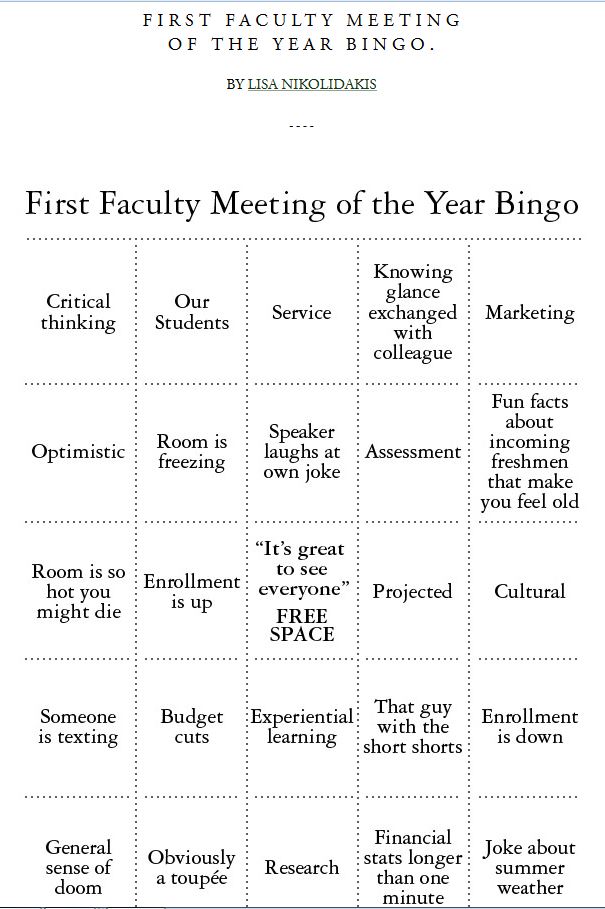
Best. Bingo. Card. Ever.
I can imagine it's disorienting to go to Convocation on your first day at work. You file in to the gymnasium behind fellow faculty you don't really know yet, not knowing what to expect. People are taking photos. For some reason that's not entirely clear to you, there are cheerleaders and a dance team. (Are they usually present at Convocations? you might ask your more experienced neighbor. No, they answer, they usually aren't.)  It's really, really cold. You wish you had a snack. You wish you had your academic robes (or, you feel kind of foolish wearing yours next to faculty who are not . . . but then, the extra fabric sure helps against the cold!). You wish, at the very least, you'd printed out that Bingo card from McSweeney's that's making the rounds of Facebook and Twitter and even, good lord, The Chronicle of Higher Education.

Then things get going. There are some opening remarks, soft joking, a general atmosphere of optimism and celebration that the more cynical of us (author raises hand here) regard with a healthy bit of side-eye. There are a few trending buzzwords from higher ed initiatives thrown around (Hey! "Initiative" -- there's one!). Still, it's interesting to observe how these things work -- these ceremonies, that is -- and what is considered worth celebrating.

Being a wise, wait, wizened, nope, seasoned (yes!) faculty member, here's what I would say is worth remembering: 
  1. The Chancellor's Excellence Awards ceremony. If you are teaching faculty, Thursday's ceremony should, at the very least, make you aware of the awards, and, at the most, help you shape the rest of your career here. These awards are prestigious and competitive, and nominations come from the college community. The nomination and selection process is rigorous at the local level and the SUNY level, and so we should look to these winners not with envy or de-facto admiration, but with a careful and appraising eye. That's not to say that award winners aren't worth our cheers and celebration -- but I'm talking about using the fact of the awards, and their distribution, not as a kind of yard stick (not something you measure your own accomplishments against), but as a source of professional-development information. Specifically: look at the bios of the awardees. Look at their accomplishments, plus the types of service they've completed and the associations they've joined. These are possibilities for your career, too -- particularly as you just begin your tenure here. What looks interesting? What looks challenging? This exercise can be useful when determining what not to do with your career, too. Not everyone gets to be (obviously) a Chancellor's Award winner -- but not everyone wants to be a Chancellor's Award winner. (Although we can all agree we'd like some cool-looking medal-bling for future ceremonies, ammaright?) If you don't want your career to include the kind of activities or markers that the award winners have, what do you want it to include? Anyway, moments like these can help you think about, early on, the kind of career you'd like to have at SCCC.
  2. The Professor Emeritus Awards: Similarly, if you listened to the biographies of the Professors Emeriti (including that of the fabulous Ellen Schuler Mauk, former president of the Faculty Association), you would have heard a long list of varied accomplishments. Here, I would point out that these former faculty members were being honored because they never stopped being active and engaged faculty after their final promotions; none of them sank into an abyss of reclusiveness and anonymity after retirement, but rather remained vigorous participants in (and advocates of) higher education. This is something to observe, and something to marvel at: how they didn't burn out. How they remained invested. It may seem difficult to imagine career burn out at this point, but in about seven years, you may find yourself a little, well, spent. Tired. And if that happens, it might help to remember and consider professors such as these. If you see any of them around campus, ask them to divulge their secrets.
  3. Dr. Suzanne Johnson's speech: As new members, you probably felt that you were getting your first good look at our administration -- President Shaun McKay, Vice President for Student Affairs Chris Adams, and of course, Vice President of Academic Affairs Suzanne Johnson. But what you may not have known is that most of the college community was having their first real introduction to Dr. Johnson, because she just began her tenure as VP this summer. Her keynote speech was optimistic, geared appropriately toward our student audience (the most substantial reason to hold a convocation in the first place), and peppered with some personal information that let us know a little more about who she is and what she values. The most refreshing revelation from this speech (and the most important) was that she, a key member of our administration, sees the community college degree not as a certificate that proves job-worthiness or -readiness, but as process, steps taken to make one a more learned citizen capable of substantial, reasoned and valuable contributions to society. This is a message I attempt to ingrain in my students every semester, as I suspect many of you do as well, but it was particularly heartening at the beginning of the academic year to hear such a sentiment from the mouth of one of our administrators.
  4. The Shark: As yes, the shark. The foam fins! The fanfare! The instrumental Metallica! (C'mon, you know you weren't missing Hetfield's hyperbolic growl.) Some of you may have been thinking, really? A mascot? Is this important and relevant, academically? The answer is, of course, no AND yes. Sure, we could survive as a commuter school without a mascot. And yes, there's often a little too much emphasis placed on sports in higher ed. But it's worth remembering your own undergrad experience, and any sporting events that you attended while there: school mascots provide students with a sense of unity and camaraderie, while the traditional humorous antics provide a kind of cathartic release from the tension that can build from too many hours of studying in isolation. Having a school mascot gives our students one more reason to feel like they belong to a college with a cogent identity, even if they commute daily to that school instead of dorming, and even if that school is divided between three campuses instead of contained in one sprawling mini-city. 
Hopefully, if anything, the Convocation gave you a better sense of the identity of SCCC, for better or for worse. Pomp and circumstance can be a little wearing, I know, and particularly after the stress of a full day of classes -- but it has its purpose, and very real ramifications, and it's important to reflect on those effects, if even for a brief while. Because faculty who are more informed and educated about the institution to which they belong, and faculty who think honestly and critically about the programs and celebrations and values of the institution, are faculty better poised to teach, and serve, and shape the future of that institution.

That's right! You're responsible for shaping the future of SCCC ... No big deal, right?

( Happy first week back!)

Tuesday, February 3, 2015

The NMDS Archive: Anticipating and Planning Your Career at SCCC, Part I


Editor’s Note:  This following is the first of the presentations from the second FA New Member Discussion Series event, hosted in cooperation with the Office of Faculty and Professional Advancement (and written by yours truly), titled "The Long View: Anticipating and Planning Your Career at SCCC," on November 14, 2014. Over the next few weeks, I'll be posting the text and talking points from the other presenters, too, so that even if you weren't able to attend the session, you'll still have access to some of the insight and advice offered at this professional development workshop. -- SKG

The Long View: Anticipating and Planning Your Career at SCCC

by Sarah Kain Gutowski, Associate Professor of English, Eastern Campus, Department of Humanities

I’m good at dreaming and planning. I come up with marvelous ideas. Putting these ideas into action, however, is another less-easy and more-challenging feat.

That’s really the impetus for this workshop today. It’s one thing to anticipate a career: to hold its opportunity, to hope, to imagine the depth and breadth of its possibility. It’s another to plan a career, which requires action in the form of decisions. Choices must be made.

One thing my career at Suffolk has made clear is the connection between choice and perspective. There’s a lot of literature out there about higher education, and about being part of the machine of higher education: it’s easy to become lost in it. A link to one article leads to another leads to a rabbit-hole of research and opinion about “shaping our nation.” But it’s almost impossible to sincerely, whole-heartedly subscribe to a belief in the system of higher education and its role in the lives of our fellow citizens unless one feels real satisfaction with, and honest acceptance for, the choices one has made within that system.
Plotting, I mean, preparing, before the presentation.

I’m a poet by trade. I write from a visceral, intuitive place inside my psyche. But systems – inorganic, exterior constructs -- are what I’m here to praise. They are not, by any means, intuitive; but the best ones allow for intuition, for choices based on gut-feelings, and for forgiveness if that intuition proves false.

Today, I’d like to help you come up with your own system, or plan, for your career at SCCC.

Your Ten Year-Plan (Or, A Letter to Yourself in Ten Years’ Time)

When you were younger, you may have been asked to write a letter to your future self. You were encouraged to ask questions of this future self, all along imagining this person and their likes, dislikes, and accomplishments.

Because no one – ever – is likely to ask you to do this again during your time here, please take a few minutes to pause and do something similar to that elementary school project. Before you groan, remember that I said similar, not the same. Ditch the “Dear Future Self” greeting. Don’t waste time with the questions about your predilections and peccadilloes. Instead, pick up one of the pens at the table, and a notepad, and with your most concise and no-nonsense words, create a verbal sketch of where you see yourself, in terms of your career, in ten years time. What is it that you want to do with your next decade?

Congratulations on what you’ve just done. It takes imagination and critical thinking skills to conceptualize one’s projected career. To use your imagination and critical thinking skills after the semester has beaten all your working brain cells into a fine pulp is no small accomplishment. You should feel a tiny sense of pride. Good job by you!

What you hold in your hand or lap, or on the table before you, however, isn’t a plan. It’s anticipation. Planning requires steps. Tiers of action. So now, let’s talk about those.

Tiers of Action (Or, Buckets of Service)

Years ago, a rather hapless administrator stumbled into a department meeting with thirty faculty members who trade in metaphor and symbols for a living, and reduced our promotion process to a series of “buckets” into which one could drop the ephemera of one’s job here. Imagine, he said, that each area of service to the college (Department, Campus, and College) was a bucket. When it came time for promotion, no one bucket should be more full than another. You could win a Nobel Prize, he said, and if your “campus” bucket was empty, there wasn’t much he could do to promote you.

You are right to laugh. Said hapless administrator was rightly mocked (not to his face, of course) for his oversimplification, which was devoid of lyricism and nuance and akin to that other elementary-school preoccupation with do-goodery, “Bucket-Filling.” Also, his allusion to buckets and a balance between them had the misfortune of producing the image of a yoke, reducing faculty to peasants – or worse – servants – or even worse -- oxen.

Sadly, the clumsiness of his words masked a more-or-less realistic view of our promotion process here. He was, in fact, on to something. Balance. (And by the way, he eventually took back what he said about the Nobel Prize. I’m not sure anyone on the Board could argue with giving that person promotion.)

Go to the FA’s website, and visit the “Professional Life” tab and scroll down to the “Promotion Information” link. Download the “A” form, which you’ll need to fill out in order to be promoted, and scroll through it. Note that on this form you’ll be describing yourself – and evaluating your own performance -- in the following areas:

  • Teaching and Other Duties (Other duties being the rather poor term to describe the daily lives of those who don’t teach)
  • Service to the College and Community (which is described, in the paragraph that follows, as encompassing your department/area, campus, college and community. We often forget this last one. Community Service isn’t widely stressed, but it’s important!)
  • Personal and Professional Growth (Or, in other words, Research and Scholarship)

Now hold up that “Future Self” sketch. Compare it to the form here. Do they look anything alike?

Probably not. But they probably should.
Sharing (hopefully) useful tips for creating balance

Practicing What We Preach: Revision and Reflection

First, Revision: 

Be patient with me, please, and take another sheet of paper out. Now, revise that original “Future Self” sketch by breaking it down into the following categories:

Daily Duties (Teaching/Non-Teaching)
Departmental Service
Campus Service
College Service
Community Service
Professional Development

Six areas. Our jobs here at SCCC are not simple – they are multi-faceted and complex, sometimes overlapping and working in tandem and sometimes in opposition to one another.

We’ll talk more about the latter in a moment. For now, let’s be positive: What – and try to be as concrete as possible – do you see yourself doing ten years from now? Think truly “big picture.” Be ambitious and idealistic. You have room to do that right now, and it will not serve you to think small.

Hint One: if you entered at the rank of Instructor, and you do everything “right” and “on time,” you will be nearing – but not quite at -- the end of your promotion cycle. If you enter at the rank of PA or Specialist, around 7 years from now you’ll be applying for your final promotion.

Hint Two: Under the “service” categories, you may find yourself a little stumped. You may not know what kind of service you CAN provide. You have lots of options, and this is also your chance to think bigger and better. Sure, most of us participate and contribute by being on committees. But you can contribute also by starting a department or campus newsletter or blog. You can contribute by leading a TLC presentation on your campus. You can contribute by organizing a professional development workshop for the college.  You can work with community partners inside and outside your classroom on unique, meaningful, and curricula-related projects. This is your moment to imagine lots and lots of options, so that you don’t feel limited when it comes to making a choice.

Now, Reflection, Part I:

After you’ve maybe taken that “Future Self” and divided him or her six different ways in this revision, sit back and reflect on what you’ve imagined. And take note – what area holds the most challenging or ambitious “Future Self”?

That most challenging or ambitious part should not be, necessarily, your highest priority – but it’s the area you want to be most conscious of and careful about. This is the area that will, most likely, lead to the highest amount of job satisfaction if you meet your goals.

And frankly, your highest goal should be to come out of this process without bitterness and resentment, or feeling cheated or roadblocked. How does one do that? Through a careful plan. Through pragmatic choices.

Then, Reflection, Part II:

This next part is not intended to be stressful or panic-inducing. Simply answer the question, where – in each of these areas – do I stand now?

I know you just arrived here. You may believe that you haven’t done more than attend department meetings and lead your classes competently, at best. But you may have done a tiny bit more than you realize. For instance: You’re attending this Professional Development Workshop. You know where that goes? Under Professional Development.  You may be a pack leader for your local boy scout troop. That’s Community Service, which really means demonstrating you’re an active and positive part of the local community.

If, after these past two months, you’ve got about two items to divide across this list – good. You’re right where you need to be. If you don’t have anything other than this workshop, you’re still right where you need to be, because where you need to be at this point is at the beginning -- but at the beginning with open eyes, with an awareness of where you’re headed.

Remember, too, that your timeline is your own timeline. You’re not racing anyone but yourself to that final promotion – and if you arrive at that finish line exhausted and depleted, feeling bitter and used, it will diminish your victory.  

Your Action Plan: Tips

1.    Make Rules for Yourself. Follow Them. Try Again if You Mess Up.

You are going to be asked to do lots of things. My advice, particularly if you’re enthusiastic about almost everything like someone else I know **cough ** . . .  is to give yourself a rule like: I must take a week to consider before beginning any new projects or commitments. If someone asks you to join a committee, say thanks, ask questions about the time commitment and the charges and tasks of the committee, and then take a few days to reflect. Answer only after you’ve taken stock of your other commitments and surveyed whether or not, realistically, you could handle the responsibility. If you can, great. If not, don’t feel bad saying no. There are lots of us at this college. They will find someone to do the work.

2.    Maybe You Have Two Careers, Not One. Plan Accordingly.

At a community college, research, publication, conference presentations, and other professional development is not the primary focus of faculty. In fact, in that list of six categories, taken directly from the A form, Personal and Professional Growth comes in last.

Some of us are just fine with that, and don’t feel a need to perform in this area beyond what’s required for our promotions. Most of us, though, came to higher education because we were interested in learning, and we specialized in very particular subject areas, and as scholars and true academics, we would like to continue to specialize, and publish, and excel, in our particular areas or fields.

For years now, I’ve answered the riddle of being a Teaching Artist at a community college by thinking of myself as having Two Careers. Two callings, intermingled at points, but that require their own separate focus. If I want to get anywhere with my writing, I need to give it time. And I have to give it time that is sacred, and set apart from my grading, my committee work, my email correspondence, office hours, and meetings.

For years now, it’s been in the mornings. Alternately – and ideally – I wake before my children and use the dark, quiet hours to write, read OR do the boring,  painful, necessary work of submitting to journals and book publishers. Since I began this practice of compartmentalizing my “twin careers,” I’ve seen a drastic increase in my productivity, as well as in my publications and presentations. Also, I’m just happier, because I’m one of those annoying people who’s happiest when I feel useful.

I try – emphasis on try – to keep these hours separate from everything else in my life, and sometimes it’s possible. Sometimes it isn’t possible. And sometimes it’s possible, but the other areas of my life suffer; I fall behind in my committee work, perhaps, or with my grading.

Generally, I forgive myself if this happens. It’s a necessary evil. If you perform perfectly in one of these areas, chances are you’re going to be failing (or flailing) in some or all of the others. There’s just too much to do, and too many demands on our time to do everything perfectly 100%, or even 25% of the time, frankly.

But as most therapists would agree – this is a good problem. There’s too much good stuff! Having a career as an academic, after all, is not a bad lot in life. What matters is that you’re being pulled in different directions by aspects of your life that you care about genuinely, and that you see the good and positive effects of your work on a regular basis, despite the chaos and stress of a fully-packed schedule.

This is, I hope, the key to a long and happy career at this college, or any college: ambition, a pragmatic approach, a willingness to forgive yourself for missteps, and the awareness that you can and will choose the direction and momentum of the events in your career. A career isn’t something that just happens to us. We build it.